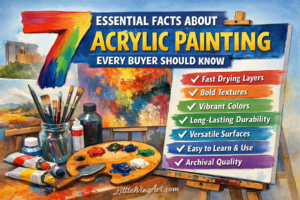
Acrylic Painting Explained as a Paint Medium
Acrylic painting refers to the use of acrylic paint, a water-based paint made from pigment suspended in an acrylic polymer emulsion. Unlike oil paint or watercolor paint, acrylic paint forms a plastic-like film once dry, permanently locking pigment in place. This chemical structure defines both how acrylic paint behaves during application and what it achieves in the finished artwork.
From a commercial perspective, acrylic painting exists as a standalone medium with its own products, formats, and buyer-driven use cases. Acrylic paint is sold in tubes, bottles, jars, sets, heavy body formulas, fluid formulas, and specialty variants such as high-flow acrylics. Buyers searching for acrylic painting supplies are not looking for interchangeable substitutes; they are selecting a medium that fulfills specific performance and finish requirements.
The defining feature of acrylic painting is speed combined with control. Acrylic paint dries significantly faster than oil paint, yet offers more opacity, layering strength, and surface versatility than watercolor or gouache. This combination positions acrylic painting as a dominant medium in modern art supply commerce.
What Makes Acrylic Paint Chemically Unique
Acrylic paint is distinct because its binder is synthetic acrylic polymer rather than oil, gum arabic, or wax. When water evaporates from the paint, the polymer particles fuse into a solid, flexible film. This process is irreversible. Once dry, acrylic paint cannot be reactivated with water.
This chemical permanence allows acrylic painting to achieve objectives other paint mediums cannot. Layers remain fixed, meaning new paint can be applied without disturbing earlier work. This enables sharp edges, clean overlays, and heavy texture without risk of bleeding or lifting. Acrylic painting is therefore uniquely suited to compositions that require structural stability.
Another result of the polymer binder is adhesion. Acrylic paint bonds to a wide range of surfaces, including canvas, wood panels, paper, fabric, plastic, and metal when properly prepared. This surface flexibility is integral to acrylic painting as a medium, not an accessory benefit.
Acrylic Painting and Drying Time Control
One of the most commercially relevant aspects of acrylic painting is its fast drying time. Thin layers can dry within minutes, while thicker applications may take longer but still cure far faster than oils. This drying speed allows artists to complete paintings quickly, making acrylic painting ideal for high-output workflows.
The finished intent achieved by this drying behavior is visual clarity. Because layers set rapidly, colors remain distinct and edges stay crisp. Acrylic painting excels at graphic compositions, high-contrast imagery, and designs where precision matters.
At the same time, acrylic painting does not limit artists to speed alone. Through retarders, slow-dry formulas, and blending mediums, acrylic paint can be manipulated to extend working time. This means the buyer is not sacrificing control to gain speed; acrylic painting uniquely offers both.
Texture and Dimensional Effects in Acrylic Painting
Acrylic painting is the only mainstream paint medium that supports extreme texture without structural failure. Heavy body acrylics can be applied in thick layers using palette knives, creating peaks, ridges, and relief that dry solid. Unlike oil paint, which can wrinkle or crack when applied too thickly, acrylic paint maintains its shape once cured.
The finished intent achieved here is physical presence. Acrylic paintings can project depth and tactility that becomes part of the visual language of the work. Texture is not merely suggested; it exists as a permanent surface feature.
This quality has driven demand for acrylic painting supplies such as modeling paste, gel mediums, and texture additives. These products exist almost exclusively for acrylic painting because other paint mediums cannot support such dimensional manipulation at scale.
Color Strength and Opacity in Finished Acrylic Paintings
Acrylic paint is known for high pigment load and strong opacity. While transparent acrylics exist, the medium excels at delivering saturated, bold color that remains stable once dry. Acrylic paintings retain their visual intensity because the polymer binder resists yellowing and does not absorb into the surface the way oil does.
The finished intent achieved is color authority. Acrylic painting allows for flat, uniform color fields, powerful contrasts, and solid coverage in fewer layers. This makes acrylic paint particularly effective for modern styles where color is meant to read immediately and decisively.
Unlike watercolor painting, where lightness and diffusion are inherent, acrylic painting asserts control over value and chroma. Once applied, color stays exactly where it is placed.
Durability and Longevity of Acrylic Painting
Acrylic painting is engineered for durability. Once cured, acrylic paint becomes water-resistant and flexible, allowing it to withstand minor surface movement without cracking. This makes acrylic paintings suitable for a broader range of environments compared to tempera or gouache.
The finished intent achieved is permanence with resilience. Acrylic paintings can be transported, displayed, and stored with less risk of damage. This durability is a major reason buyers choose acrylic painting for both decorative and commercial artwork.
From an archival standpoint, modern acrylic paints are formulated to resist fading and environmental degradation. While no paint medium is entirely immune to time, acrylic painting offers a balance of longevity and practicality that appeals strongly to buyers.
Acrylic Painting Compared to Other Paint Mediums
Acrylic painting occupies a unique position between oil painting and watercolor painting. Unlike oil paint, acrylic paint does not remain workable for extended periods, but it also does not require solvents or long curing times. Unlike watercolor, acrylic paint does not rely on the paper surface or transparency to define the image.
The finished intent that sets acrylic painting apart is predictability. Acrylic paint behaves consistently once dry, allowing artists to plan outcomes with confidence. This predictability is essential for buyers who need repeatable results, whether producing multiple works or working under time constraints.
Because acrylic paint can imitate aspects of other mediums through additives, acrylic painting often serves as a single-medium solution. However, the final appearance remains distinct due to its surface finish and structural properties.
Surfaces and Application Scope of Acrylic Painting
Acrylic painting supports an unusually broad application scope. Canvas remains the most common surface, but acrylic paint performs equally well on wood panels, illustration board, and primed surfaces. With proper preparation, acrylic painting can extend to unconventional supports without compromising adhesion.
The finished intent achieved is versatility without compromise. Acrylic paintings do not require the surface to absorb paint, unlike watercolor, nor do they demand rigid supports like encaustic. The medium adapts without losing its defining characteristics.
This adaptability drives continued commercial demand for acrylic painting products across skill levels, from beginner sets to professional-grade paints.
Why Buyers Choose Acrylic Painting
From a buyer’s perspective, acrylic painting represents efficiency, control, and reliability. Acrylic paint is accessible, scalable, and adaptable, making it suitable for a wide range of use cases without changing mediums.
The finished intent achieved by choosing acrylic painting is visual certainty. What is applied is what remains. Colors stay bold, textures stay raised, and compositions stay intact. This reliability is not incidental; it is the defining promise of acrylic painting as a medium.
For this reason, acrylic painting remains one of the most searched and purchased paint categories in the art supply market.